

10 Best Ways to Turn a Profit Sourcing Amazon Products From India
- Published
- Updated
If you're a new seller on Amazon, your life must be jam-packed with challenges. Everything from getting more visibility to keeping sales and purchases moving can be difficult. And one of the hardest of these remains: turning a profit.
While there are a lot of factors that go into making a profitable business as an Amazon seller, sourcing products the right way is one of the biggest. The aim of sourcing products is to increase margins, save cost wherever possible, and reduce transit and delivery times while still getting a fair shipment price. Sourcing Amazon products from India can do a good chunk of that, provided your product is the kind of product India is good at.
Wondering why you should source products from India for eCommerce? And if you do, how can you make a huge profit? Read on to find all your answers.
One note before I start. I wrote this with US Amazon sellers in mind because that's who kept asking me, but most of it holds if you sell on Amazon Australia, the UK or anywhere else. Where a point is US-only I say so.
Why Should You Source Products from India?
There are many reasons why sourcing products from India may be a better choice for your business, but let me clear one thing up first. You'll read everywhere that India's own market is booming. True, and beside the point. A big domestic market doesn't make a country good to buy from, and it can even work against you because every commodity has tremendous demand at home too.
What matters is what India makes well, and that list is specific: cotton and most of the world's organic cotton, jute at about three quarters of world output, craft goods from the 42 towns the government designates as export towns, value-added garments like babywear and embroidered tops, and metal parts made to drawing. It's weaker on plain basics at scale, on synthetics and on speed, and its share of world apparel exports has sat at about 3% for fifteen years. So ask whether your product is one India is good at, rather than whether India is cheap. Our team has laid the evidence out on why India, and when not.
One more myth while I'm at it. You'll also read that Indian goods carry less quality risk because manufacturers go through rigorous safety testing. Nobody tests Indian factories on your behalf. The border data says the opposite - the US FDA refused 19,963 entry lines from India between January 2021 and August 2026, and India was the most-failed origin in Australia's imported-food tests every year from 2021 to 2025. For the non-food goods you'll sell on Amazon the picture is calmer (130 EU Safety Gate alerts over the same period), but the failures are the kind a spec would have caught: chromium VI in leather, cadmium alloys in fashion jewellery, drawstrings on kids' clothing. Quality in India is what you specify and test. See quality control in India.
If you're looking for unique or hard-to-find items then sourcing them from India might be the best option. Here are some reasons why India is an excellent place to source various products.
1. You Get Unique Products
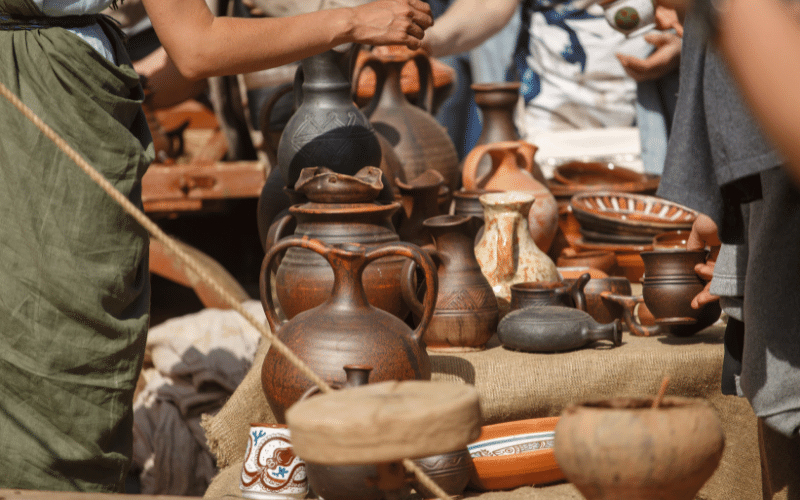
India is home to a diverse group of artisans and craftspeople. The products you can source from here include excellent handmade goods, jewelry, and textiles you can't find in other places like China or Indonesia.
Such products can sell incredibly well on sites like Amazon and eBay because they're unique and different. One thing to know though. In craft towns like Moradabad, Jodhpur and Saharanpur, the workshops make to order for export houses and rarely sell direct, so you'll usually buy through an exporter rather than the artisan. That's a normal way to run a craft cluster, and it's how most Western home-decor aisles are supplied. Ask who makes your goods and who answers for quality, and you're fine.
2. Low MOQs Are Possible, With Honest Caveats
For a new Amazon seller, affording high minimum order quantities can be a bit of a challenge. And yes, you'll find Indian suppliers who take small orders. But I'm not going to tell you it's easy, because it isn't.
Nobody publishes minimum order quantities for India, and there's no norm. Buyers on trade forums (2024 to 2026) report roughly 200 to 500 pieces per style at established knitwear factories, about 100 at small units, and 1,000 from traders. One Tiruppur unit advertises 30. Those are reports, not rules, and the next factory will differ.
What actually sets the MOQ sits upstream of the factory - the dye lot at the mill, the screen set-up for a print, a separate minimum for every colour in every size, and the packaging run, which often has a higher floor than the product. So negotiate the driver instead of the number. Fewer colours cuts dye lots. Fewer sizes cuts size minimums.
And below a few hundred units, India is often not cheaper once freight, duty and your own time are counted. Start small by all means, but do the landed-cost sum first. The full picture is on MOQ, pricing and payment terms in India.
3. You Can Find Export Focused Factories
India is one of the most populated countries in the world. So every commodity has a tremendous domestic demand as well. Despite this, there are hundreds of suppliers mainly focused on exports and who only cater to foreign businesses.
This is a great advantage because these suppliers are familiar with legal and logistical export requirements. Sourcing from them will take that load off your back.
There are, broadly, two kinds of Indian factory. One exports everything it makes to large brands. The other sells at home and is just starting to export. They're different experiences, and most of the horror stories you'll read come from the second kind. Smaller upstarts can be just as good, but checking is what tells them apart. And don't be put off if the company you're talking to is a merchant exporter rather than the maker. Both are normal business models in India. You just need to know which factory makes your goods.
4. Lower Costs, For the Right Product
Everyone says Indian labour is 20 to 30% cheaper than China's. I couldn't find a source for that number and neither could our research team, so I won't repeat it.
What I can show you is a customs value. A cotton T-shirt from India entered the US at US$1.83 a piece in 2025, against US$2.61 from Viet Nam and US$1.63 from Bangladesh (UN Comtrade, importer-reported). So India beats Viet Nam by a wide margin and loses to Bangladesh on plain basics. Where India wins is fibre: it grows most of the world's organic cotton and holds about 28% of the world's GOTS-certified facilities, against Bangladesh's 9%.
If you are not too deep-pocketed, choosing an Indian supplier will help you save money and still get good quality products. Just pick a product where India's cost edge is real.
What are the Best Products You Can Source from India?
Here's a list of all the great products that you can source from India:
- Textiles, Including Raw Clothes Or Finished Clothing Pieces
- Sarees Or Indian Ethnic Wear
- Musical Instruments
- Jewelry (Specifically Glass Bangles)
- Handmade Home Decor
- Goods Made From Eco-Friendly Fibers Like Jute
- Watches
- Leather Goods, Including Bags, Shoes, Belts, Wallets, Etc.
- Wooden Furniture Or Toys
A few of these have numbers behind them, which I like. India supplies about a quarter of the babies' knitted garments imported by the UK, the US and Australia, 38% of the rugs the US imports, and 57% of the UK's jute sacks and bags (UN Comtrade, 2025). Apart from these, there are several other products you can get from India for eCommerce. The longer list, with the evidence, is on what you can source from India.
Ways to Increase Your Profit While Sourcing Products from India
1. Source From an Expert
You may find several suppliers for the same product in India. But it's always the best idea to do your research and find out which one of them is known for the product quality and their R&D.
An expert supplier who deals primarily in one category of products will also offer you better pricing and service. Their quality will be superior, and you won't have to worry about delivery times either.
If you don't know whom to trust then someone on the ground can find the maker and check them for you. SourcingSync (opens in a new tab) does exactly that.

2. Be Mindful of Minimum Order Quantity
If you're a new seller with limited funding and a small-scale business, you need to be careful about choosing your supplier.
Many large suppliers and factories have a very high order minimum quantity requirement which you might not be able to afford. Their pricing would surely be better, but the amount of stock you'll need to order will defeat the advantage of getting a low price. So research low MOQ manufacturers and approach them, and remember the trick from above - ask for the product MOQ and the packaging MOQ in the same enquiry, because the higher one is your real MOQ.
On the other hand, for a business with a substantial product requirement, low MOQ manufacturers don't cut it. They can't fulfill large orders, and their pricing isn't beneficial either. Such large sellers, therefore, should choose big manufacturers.
3. Focus On Quality Over Price
In a 2018 First Insight (opens in a new tab) survey of US consumers, 53% said quality was the most important factor in a purchase, against 38% for price. Your customers aren't looking for a cheap but low-quality product. So you shouldn't be laser-focused on pricing instead of quality with your supplier either.
If you negotiate with suppliers to get an incredibly low price, they'll compensate for the amount lost by providing you with poorer quality. Not out of spite. A price below cost leaves a factory two choices, lose money or cut a corner, and you can guess which one gets picked. This might not seem like a big deal at first, but it will become a massive headache when your customers leave bad reviews and go away from your business.
Small orders carry their own risk here, and it's worth knowing the mechanics. Buyers on forums report small knit orders cut straight off the roll without a relaxation rest, which then shrink 5 to 8% after the first wash, and bulk quietly sent to a subcontractor the buyer never saw. The fixes are boring and they work: write a maximum shrinkage into the spec, ask for photos of your goods on their line at about 10% completion, and inspect before shipment no matter how small the order.
So, always go for superior quality, even if you have to pay a little extra. You might have to switch suppliers to get the best quality products. But the efforts will be worth it when you see an increase in profitability.

4. Choose A Supplier From A Production Hub
India's diverse economic and geographic outlook has made the country such that each region specializes in a particular category of products. When you're sourcing products for your eCommerce business on Amazon or eBay, you should make an effort to find a supplier from a specialized region in the country.
For your convenience, here are some cities in India with the goods they specialize in. I've checked these against the government's own export-town list (DGFT, April 2023) and Uttar Pradesh's district product portal, and corrected myself where the reputation and the record differ -
- Tiruppur: Knitwear, T-Shirts, Babywear (Knits Only, Not Wovens)
- Firozabad: Glass Artware Like Bangles, Vases, Decorative And Utility Glassware
- Kanpur: Leather Footwear, Saddlery, Bags And Belts
- Moradabad: Metal Handicrafts. Famous For Brass, But Its US Sea Trade Today Is Mostly Iron, Steel, Aluminium, Glass And Wood Decor
- Varanasi: Handloom And Handicraft, Banarasi Silk Sarees And Brocade, Wooden Toys And Lacquerware
- Panipat: Blankets, Carpets And Bed Linen
- Jaipur And Jodhpur: Handicrafts. Jaipur's Garments And Block Print Are Reported By Suppliers, Not On Any Official List Yet
- Bareilly: A Ministry Of Textiles Handicraft Cluster, Not On The Export-Town List. Its UP One District One Product listing is zari-zardozi embroidery
A designation tells you where to look, not whom to trust. For a complete list of all the regions and the products they are hubs for, see India's manufacturing clusters.
5. Bargain Well
India isn't a market of fixed prices. When you're talking to Indian suppliers for sourcing anything, you should be prepared to bargain and negotiate on price and delivery conditions.
Asking about price is what you should do once you've selected a supplier or two and discussed the details of your deal, including product type, delivery time, etc. Do know that you should only bring the costs down a reasonable amount, or you may lose the deal.
Know the price ladder too. The listed price in a directory is a starting point and often a stale one. The quote comes next. Then, if you're not careful, extra charges appear after the order or the deposit, usually labelled "export packaging". Buyers on forums have described all three steps for years. So get an all-inclusive price in writing, with the Incoterm and the named port on it, before any deposit leaves your account. "FOB" without a port is not a price (what FOB actually covers).
To understand what prices are appropriate, you can talk to experienced industry professionals in your network or do more online research. Once you've finalized the prices, place an order.
6. Request Additional Services
Sourcing doesn't end at finalizing a price for your order. There's a lot that goes into making your batches perfect.
Once you are done negotiating the price, inquire about the supplier to see if they offer services like labeling, packaging design, etc. Manufacturers usually have close ties with ancillary vendors and can help you achieve your goals at a lower cost. Do remember that printed cartons, tubes and moulds carry minimums of their own, so ask about them at the same time as the product.
These might seem like small things but can make a huge difference over time as you seek to increase your profitability and add new products to your Amazon store.
7. Ask for a Warranty
Warranty is another aspect customers value, and on Amazon a listing that stands behind the product tends to look better next to one that doesn't.
But when you're just a seller, it's not up to you to provide any warranties on the manufacturer's behalf. What you can ask your supplier for is a defect clause in the order: replacement or credit for defects found within an agreed period, with your inspection report as the trigger. Put it in writing before you pay.
With that in place, you can list your products for a slightly higher price and offer the warranty to your customer yourself. If the manufacturer doesn't offer anything, you as a seller can still opt to offer a warranty and deal with RMAs yourself. Just price it in.
8. Keeping An Eye On Transit Times
India's diverse geography matters for more than knowing the product hubs. When I first wrote this I said the main port was Mumbai or Chennai. Let me be more precise, because your transit time depends on it.
For the north and west, the big container gateways are Nhava Sheva (JNPA, in Navi Mumbai) and Mundra in Gujarat. The northern clusters - Moradabad, Kanpur, Jaipur, the Delhi apparel belt - sit roughly 1,000 km or more from either in a straight line, and the road or rail leg is longer than that. Mundra is the closer of the two for most of them, though the dedicated freight corridor to Nhava Sheva was completed in March 2026, so that gap is narrowing. For the south, cargo leaves through Chennai, Tuticorin or Cochin. And here's the one that surprises people: a large share of Tiruppur knitwear bound for the US loads at Colombo in Sri Lanka, not at an Indian port at all, because southern cargo is fed there and put on the US-bound ship (US bill-of-lading records, our analysis).
So ask your supplier which port your goods will actually leave from, and name it in the quote. Then add the inland leg, port dwell and, in mid-2026, three to nine days of congestion at Nhava Sheva. Consider these transport times when estimating your products' arrival dates. That will help you restock effectively and save you some time and effort. The whole path a box takes, hubs and all, is in how sea freight gets from Asia to you.

9. Receive Products on the East Coast (US Sellers)
This one is US-specific. Back in 2022 I said the East Coast was far cheaper than the West Coast. I can't put a number on the cost gap, and I don't trust anyone who does, because no India-origin freight rate index exists. What I can tell you is dated and it's about days.
As of the carrier schedules our team read on 23 September 2026, the East Coast has direct services from western India: Mundra to New York in about 30 days, Nhava Sheva in about 33, and Nhava Sheva to Savannah in 28 days via Suez. The West Coast has no direct service in any schedule we read. Every routing transships, with medians of 45 to 58 days. A direct sailing usually beats a relay on days and on handling, so unless absolutely necessary, give your supplier an East Coast address, and get both coasts quoted. Routings change on short notice, so ask your forwarder for a dated transit time with the routing named. The current picture, Suez or Cape included, is kept up to date on sea freight routes.
You can easily choose your "ship to" location as a city on the East Coast. Some options include NYC, New Jersey, Savannah, etc. Using these will help you land an Amazon warehouse near these cities. Then you can receive all your products directly in the warehouse. Although it is a good idea to get products on the East Coast, you should ensure that you have a strong domestic distribution chain set up before you order.
While we're on US-only points, the tariff. As of 24 September 2026, Indian goods pay the normal MFN rate plus 10% under Section 301, or the Section 232 rate instead where a product is on a 232 list (25% on upholstered wooden furniture, and steel and aluminium "derivatives" like fasteners and kitchen tools). De minimis is gone, so every parcel is dutiable and formal entry applies above US$250. The 18% and 50% you may have read about are history. How to work the full number out, MFN plus the 10% plus what the duty is charged on, is in working out the real import duty. Details and dates: importing from India to the US. Selling in Australia, the UK or New Zealand instead? Your duty on Indian goods is 0% since 1 January 2026 in Australia, 0% on the consumer lines we sampled since 15 July 2026 in the UK, and 0% from 20 October 2026 in New Zealand.
10. Stick With A Supplier
If you have no complaints from your supplier, don't be afraid to stick with them for the long term. Doing this will help you build long-lasting relationships with the supplier and receive better deals in the future.
Your supplier will start trusting you better once you've placed a few orders. That'll make them give you seasonal discounts and added perks. It also loosens payment terms, which is the perk that matters most. Small makers commonly ask a new buyer for 70 to 100% up front, and exporters on forums give the same reason every time - foreign buyers, including long-standing ones, have paid late or not at all. Documents against payment is the usual middle ground, and what each payment method protects is a guide of its own. After a few clean orders, you'll find the advance shrinks.
Now Go, Make That Bread!
Using my tips above will help you increase your profitability while sourcing products from India. The key is getting the best deal possible while not compromising even slightly on quality.
If you have more questions about suppliers and manufacturers or want more advice regarding sourcing in general, be sure to leave a comment below. Hope this helps.