

Private Label Manufacturing in India: Protect Your Brand
- Updated
In June 2025 a small Indian clothing exporter posted something private-label buyers rarely hear said out loud (r/streetwearstartup, 2025 (opens in a new tab)). For years it had made goods for European wholesalers under their labels. "We're barely making profit - just surviving - while they're making strong margins from our designs and craftsmanship," it wrote. Some of those older clients had paid late or not at all. So that year, for the first time, it was going to Boom Festival and Modem Festival in Europe to sell under its own name.
We don't read that as a warning about Indian makers. It's a business growing up, which is exactly what you'd want from a supplier in any other context. But put yourself in the shoes of one of those European wholesalers for a minute. Whose designs were they, on paper? Who owned the patterns, and was there a clause about any of it? This page is about answering those questions before the first sample, not after your range turns up at a festival stall. One honest caveat - Indian case law on contract manufacturing is thin, so where we're giving drafting practice rather than a ruling, we say so.
The decision in brief is in the playbook: Private label and customisation.
1. Agree What the Words Mean First
The words travel badly between countries, and in India they're used loosely. "Private label (their formulation, your label), third party (your formulation, they produce), or full custom development … people use those terms interchangeably," as one Indian practitioner put it in 2026 (r/IndiaBusiness (opens in a new tab)).
That matters because ownership follows the job. With private label in the Indian sense, the maker usually owns the formula or design and you own only the brand on it. Third-party manufacturing usually means your formula on their line, though sometimes it's a shared base formula adjusted for you. Custom development should leave you owning the result, but only if the contract says so, and "OEM" means whatever the contract says it means. Contract manufacturing or job work is the cleanest - you supply or specify, and they run the machines (our reading of how buyers describe their contracts, Indicative).
The European wholesalers in our story were probably somewhere in the middle, and that's the dangerous place to be. So write the ownership line out in full: "The formulation, artwork, patterns and tooling created under this order belong to the buyer." If a maker resists then you've learned something useful before the deposit leaves your account.
2. Register Your Trademark in India Before You Share the Logo
You have two routes. A national application goes to the Indian Trade Marks Registry directly, usually through an Indian attorney. A Madrid designation extends a mark you already hold at home to India through WIPO, since India acceded on 8 July 2013 (WIPO Lex (opens in a new tab)). Madrid is simpler to run across several countries, but a national filing gets you an Indian attorney watching the register, which is worth more than it sounds.
Either way, file before you share the logo. You'll hear that India is "first to file", and that's not quite right. Section 34 of the Trade Marks Act protects an honest prior user, but the use has to be in India, proven with dated invoices to Indian customers, dated marketing and dated listings (Intepat (opens in a new tab), Lexology (opens in a new tab), current). A foreign brand rarely has any of that. Your years of sales in Sydney or Leeds count for nothing in Chennai, so filing, not reputation, is your protection.
3. What an Indian NDA Can Actually Hold
"NNN" stands for non-use, non-disclosure and non-circumvention, and it's the agreement most buyers reach for. Under Indian law the first two hold up well during the relationship. What doesn't hold is a restraint that runs after it ends, because section 27 of the Indian Contract Act treats those as generally void, as the Supreme Court applied in Percept D'Mark v Zaheer Khan (2006), while restraints during the term were upheld in Niranjan Shankar Golikari (1967) (Indian Kanoon (opens in a new tab), Nishith Desai (opens in a new tab), Supported).

So build the agreement around the term you're actually in. Name the subject matter in a schedule - the designs, formulas, tooling, artwork files and customer information the maker receives - because a vague "all confidential information" is far harder to enforce. Say the maker may use those items only to fulfil your orders, and may not share them with sister companies, sub-contractors or other brands without your written consent. Name the sub-contractors it may use.
If you want exclusivity, say so, define "same product" tightly and let it end when the contract ends. Then say what happens to files, samples and tooling at the end, and set Indian law with arbitration seated where your Indian counsel advises. Would that have stopped our exporter going to Boom Festival with its own designs? No, and it shouldn't. But it would have stopped it selling the wholesaler's scheduled designs while the two were still working together, which is the part that counts. Take Indian legal advice on the wording, because we've read the cases at "Supported" and your lawyer will read them in full.
4. Tooling, Moulds and Patterns: Who Owns What
We found no India-specific source on tooling ownership in contract manufacturing, and no Indian ruling on a dispute over it. What follows is contract drafting practice, not case law. It's also the reason the clause matters, because silence leaves the question to whoever is holding the mould.
State that the moulds, dies, screens, patterns, lasts and blocks you paid for are your property, held by the maker as bailee. Have them marked as yours and listed in a schedule with photographs. Say they're never moved or copied without your consent, where they go at the end, and who pays for wear and replacement. It's a dull paragraph, and it's the one you'll be glad of the day you move suppliers.
5. Ask Who Holds the Certificate
With contract makers, the company quoting you often isn't the company holding the certificates. "On vetting: ask who holds the certifications," the same practitioner advised (r/IndiaBusiness, 2026 (opens in a new tab)), and a production agent warned separately to "watch out for hidden tier-2 sub-contracting" (r/StartUpIndia, 2026 (opens in a new tab)).
That's normal in a market built on sister companies, and it isn't a red flag by itself. It just means you check the certificate against the unit that will make your goods, which is how you look it up on how to verify Indian suppliers.
6. Packaging: Minimums, Components and Surplus
Packaging often sets the real minimum on a private-label run. One Indian practitioner put cosmetics contract-manufacturer starting points at 1,000 to 3,000 units per SKU for jars and bottles, and "tubes are worse, often 6,000-10,000 per SKU" (r/IndiaBusiness, 2026 (opens in a new tab)). That's one person's numbers, not a norm, but it shows the shape - the pack format moves the minimum more than the formula does. Why the upstream minimums stack up this way is on MOQ, pricing and payment.
Some components are also hard to find locally. An importer in India said in 2026 that "even basic things like matte finish HDPE bottles are not available here" (r/IndiaBusiness (opens in a new tab)). One voice, and a grumpy one, but if your brand depends on a particular finish then ask early whether it's made in India or imported, because an imported component adds time.
Then the artwork. Send final files with a version number, get a digital proof back and, for packaging, a physical strike-off, and approve in writing naming the version. No approval, no print run. The maker prints only the PO quantity plus an overage stated as a number. At the end, surplus labels, cartons and tubes are counted and either shipped to you, held for your next order or destroyed with a photo record, and the PO says which. That last step is the one most POs miss, and branded packaging left in a store room is how a brand's boxes turn up on goods it never made.
7. Labels Your Destination Demands
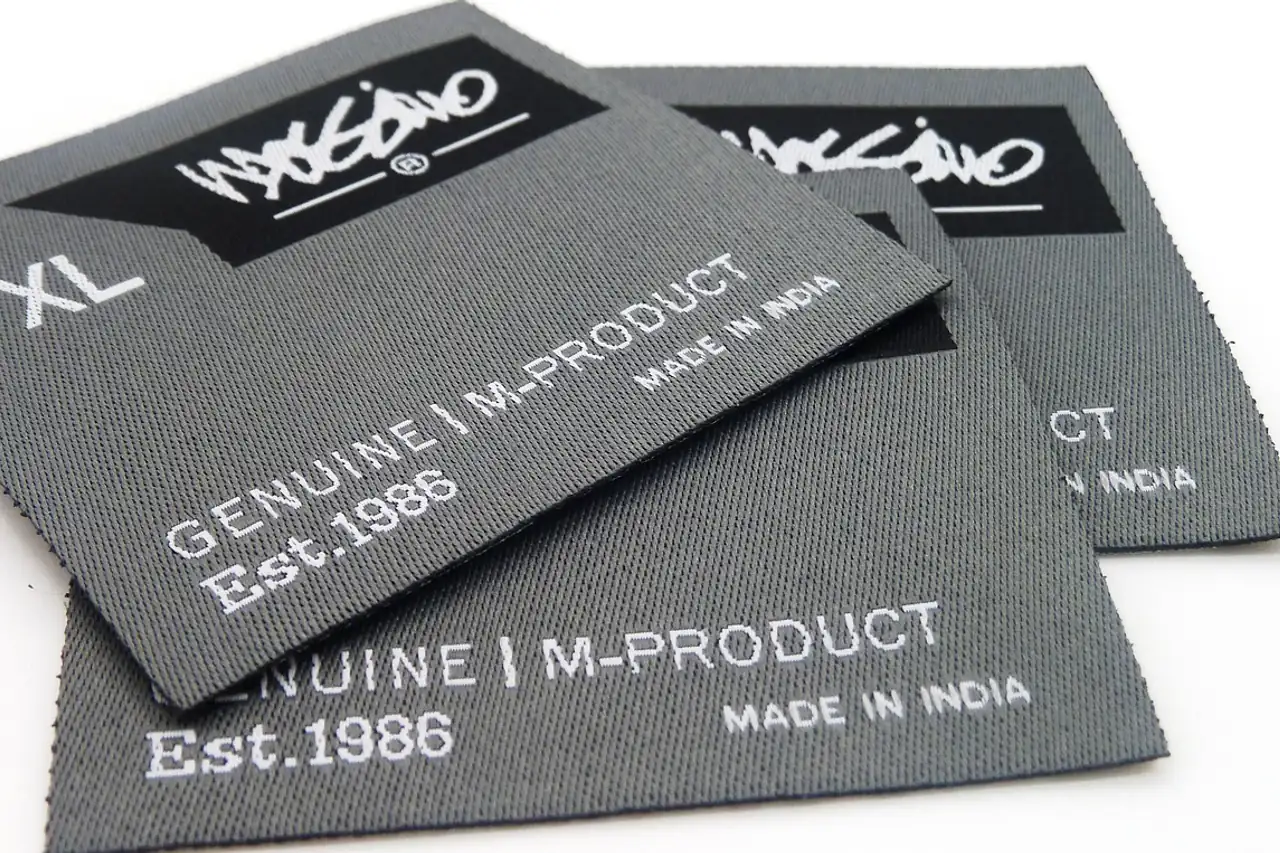
The maker prints what you send, so send the right thing, as a PO attachment in your destination's exact wording. For textiles, the EU wants fibre names and composition in its set terms under Regulation 1007/2011 (opens in a new tab), and the US wants fibre content, country of origin and an RN or company name under the FTC textile rules (opens in a new tab). Australia has a mandatory care labelling standard (opens in a new tab), and the UK sits under its own GB product-safety framework (opens in a new tab).
The detail for each lives on its trade page - the EU, the UK, the US and Australia.
8. Cosmetics: Where Indian Goods Actually Fail
Our own count of border records says exactly where private-label cosmetics from India go wrong. In the EU, Lilial (butylphenyl methylpropional, BMHCA), a fragrance ingredient banned in EU cosmetics but still sold in India, sits behind 32 of the 62 EU Safety Gate alerts on Indian cosmetics from 2021 to September 2026, mostly in perfumes, attars, body sprays, soap and hair oil. Hair-dye amines such as PPD are the next biggest group at 14 (EU Safety Gate (opens in a new tab), our count). So for the EU and UK, ask for an allergen declaration on every batch, not once at onboarding.
The US problem is colour. FDA Import Alert 53-06 on unapproved colour additives lists 97 Indian firms as of September 2026, with yellows like tartrazine and quinoline yellow leading the charges (FDA import alerts, our count). Ask which colours are in the formula and check each against the FDA list. And keep drug claims off the pack - "treats", "cures" and "heals" turn a cosmetic into an unapproved drug at the US border. The test plan is on quality control in India.
9. UK Buyers: Claiming Origin on Your Own Knowledge
Under the India-UK CETA, in force since 15 July 2026, a UK importer can claim the preferential rate on its own knowledge that the goods originate, as well as on an exporter's declaration or a certificate. For a private-label buyer who specifies the fabric and knows where it was made, that's a genuinely useful route. Details are on the UK trade page.
Ready to act
Need hands-on help?
Lock ownership and exclusivity before the first sample. SourcingSync can negotiate and hold the terms.
Back to the Festival Stall
That Indian exporter will probably do well at Boom, and good luck to it. The wholesalers who come out fine are the ones who filed their marks in India, scheduled their designs, owned their patterns on paper and paid on time, because their maker had nothing of theirs to take and no reason to want to.
Private label in India works, and works at scale. It just runs on paperwork that most buyers leave until it's needed, and by then it's too late to write.
What We Don't Know Yet
We don't know what ownership and exclusivity terms Indian contract makers offer as standard. We have a few practitioners' accounts, and we won't generalise from them. Packaging minimums for private-label runs, category by category, aren't published anywhere we've found. And we haven't found an Indian court ruling on tooling ownership in a contract-manufacturing dispute, though we'll keep looking.