
India Sourcing Overview
- Updated
The decision in brief is in the playbook: India at a glance → /india/#overview
Back in October 2023, a buyer from Belgium posted a question most first-time India buyers ask in some form. Where should I make my range? The answer came from an Indian maker, and it was blunt: "Tirupur is great if you need massive quantities. They specialize in knits, and thats it" (r/streetwearstartup, 2023 (opens in a new tab)). Wovens, the maker said, meant another city altogether.
We like that answer because it's the shape of the whole country. India is one of the largest exporters on earth, but you'll never buy from "India". You'll buy from a town, a trade and a small firm, and most of the work is picking the right one of each. This page gives you the big picture in numbers you can check. It won't tell you which supplier to use, because the big picture never can.
1. What India Actually Sells
India's goods exports in FY2025-26 were US$441.78 bn, up 0.93%, by the Department of Commerce's quick estimates of 15 April 2026 (PIB (opens in a new tab), annexure (opens in a new tab)). The six biggest groups were engineering goods (US$122.4 bn), petroleum products (US$53.9 bn), electronic goods (US$48.0 bn, up 24.4%), drugs and pharmaceuticals (US$31.1 bn), chemicals (US$28.7 bn) and gems and jewellery (US$28.2 bn). The figures for the year are provisional.
Four of those six aren't what a consumer-goods buyer imports. The groups most of our readers care about sit further down: ready-made garments at US$15.77 bn (down 1.36%), cotton yarn, fabrics and made-ups at US$11.59 bn (down 3.89%), leather at US$4.27 bn, spices at US$4.26 bn and carpets at US$1.46 bn, all a little down on the year (same annexure). So India today is a large industrial exporter with a deep fibre and craft base underneath it, and it's that base where small foreign buyers usually find their first supplier.
Two readings matter more than the ranking. Petroleum was the only big group that fell hard (down 14.95%), which is why the non-petroleum total grew 3.62% while the headline grew under 1%. And electronics added more dollars than any other group, about US$9.4 bn in a year, because smartphone assembly moved to India on the back of a production subsidy (PIB explainer (opens in a new tab)). If someone tells you India's exports are flat then they've read the headline.
A later government release puts goods and services together at a revised US$863.1 bn for the year (PIB (opens in a new tab)). Ignore it for sourcing. You can't put services in a container.
2. Who Buys From India
The US is India's largest market by far, at US$87.31 bn in FY2025-26, or 19.8% of goods exports. The UAE follows at US$37.37 bn, then China, the Netherlands, the UK at US$13.44 bn and Germany. Australia took US$7.28 bn, which is 1.6% (Department of Commerce quick estimates as above, shares our arithmetic). Add up the six largest EU member states and they take at least US$57.5 bn, so the EU as a bloc is India's second market even though no single member state gets near the UAE.
What does this mean for you? If you buy from Australia or New Zealand then your market isn't where India's exporters are looking. That cuts both ways. There's less competition for good factories, and there's also less experience on the supplier side with your labelling, biosecurity and origin rules. Expect to explain your border to your supplier, not the other way round.
The Australian figure also hides a trap. Exports to Australia fell 15% on the year, which sounds like trouble. Strip out fuel and they grew, because petroleum products fell by US$1,773 m while every other group together rose by US$476 m (our analysis of DoC TradeStat (opens in a new tab) and ABS (opens in a new tab), FY2025-26). The same trick works for any country that buys refined fuel from India.

3. How The Supply Base Is Built
Micro, small and medium firms shipped 48.55% of India's exports in FY2024-25, through about 1,73,350 exporting MSMEs (KNN India, citing a government reply (opens in a new tab) · Reported). Behind them stand 5,38,17,971 firms registered on the Udyam portal, of which 98.8% are Micro (our arithmetic from the Udyam portal's (opens in a new tab) live counters, read 25 September 2026).
Put those numbers side by side. Tens of millions of registered firms, and under two lakh exporting. The gap between them is your shortlist problem, and it isn't a quality problem. A firm that has never exported may be an excellent maker that sells to a domestic brand, or to a merchant exporter who ships its goods under another name. That's how India's trade is organised, not a trick.
So your real job is working out which role each firm plays and who answers for quality. You can do a surprising amount of that from public records before you spend anything on travel. What the records prove is identity and export registration. What they never prove is quality or capacity. The checks, record by record, are in Checking suppliers, and the roles themselves are in Who you can buy from.
4. Where Production Sits
This is where the Belgian buyer's answer comes back in. The DGFT's list names 43 Town of Export Excellence designations covering 42 towns (FTP Appendix 1B, 6 April 2023 (opens in a new tab)), and it's a decent map of where the export trade lives. Tiruppur is listed for hosiery and knitwear, not for apparel in general. Panipat is home textiles, Morbi is ceramic tiles and sanitaryware, and Moradabad is metal handicrafts, which today means iron, steel and aluminium as much as the brass it's famous for.
Each cluster has its own port, its own association and its own way of quoting. Tiruppur's trade sizes a T-shirt by its tubular chest width in inches, not by S, M and L (an Indian bulk buyer on a forum, about 2018, one voice). Moradabad's small workshops make to order for exporters and rarely sell direct. Those differences are why "India" is the wrong unit. The textile industry page covers the fibre side, Tiruppur shows one cluster in practice, and Where production sits helps you pick yours.
5. Infrastructure, In Brief
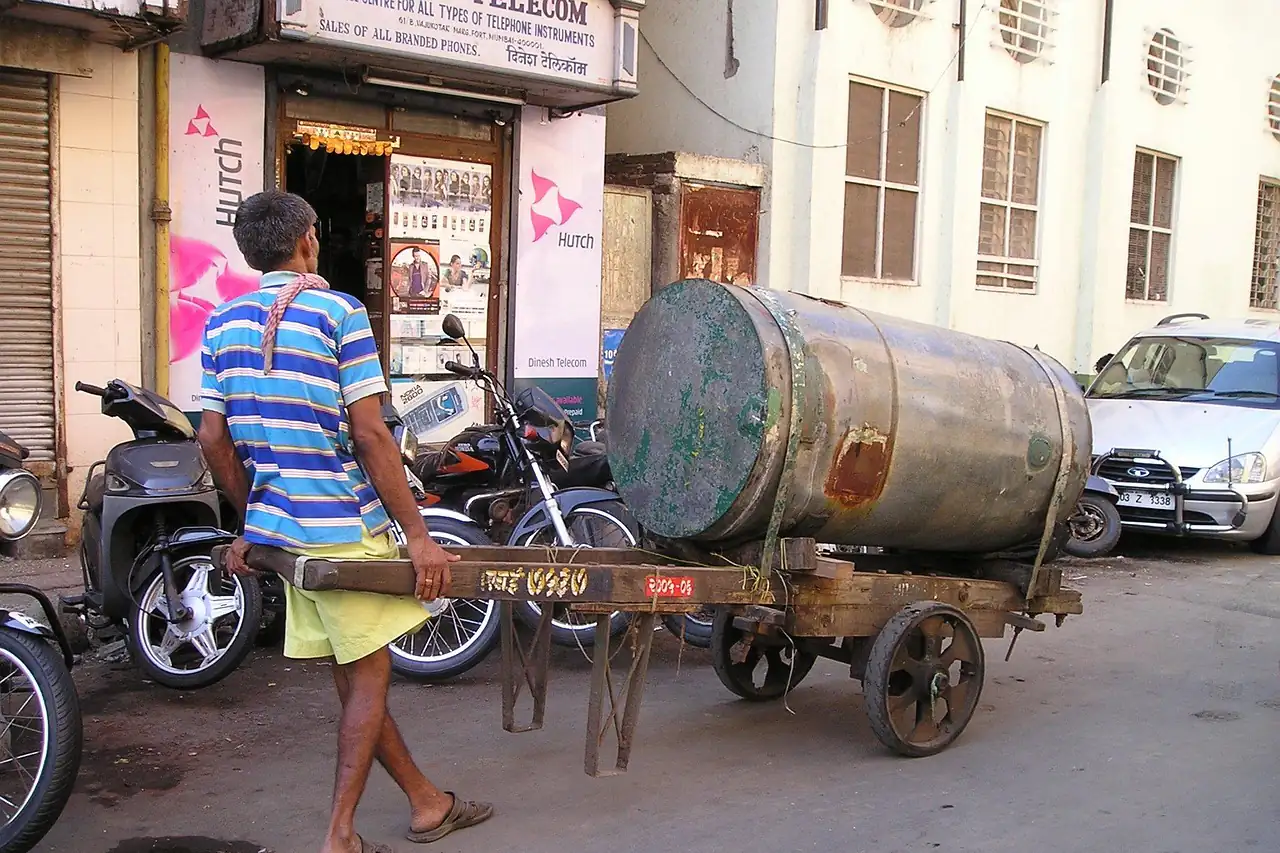
India ranked 38 of 139 countries on the World Bank's Logistics Performance Index in 2023, up from 44 in 2018 and 54 in 2014 (PIB (opens in a new tab) · Supported). The major ports handled 914.7 million tonnes of cargo and 14.92 million TEU in FY2025-26 (Ministry of Ports, Shipping and Waterways, March 2026 (opens in a new tab)), and all airports together handled 3.96 million tonnes (Airports Authority of India (opens in a new tab)).
None of that tells you how long your goods take. The number that matters is your cluster's port and the lane from there to your country, which can be a single ship to Rotterdam or two ships and a hub to Auckland. That's in Exporting and trade.
6. Trade Policy, In Brief
The Foreign Trade Policy 2023 set a target of US$2 trillion in exports by 2030 (Business Standard, 31 March 2023 (opens in a new tab) · Reported). Two programmes matter to a buyer. PM MITRA is building seven integrated textile parks for fibre-to-garment production on one site (PIB, December 2025 (opens in a new tab) · Supported), and the production-linked incentive schemes are behind the electronics jump.
Here's our honest read - both reward large, formal exporters. They change little for the small maker in a cluster, who is the supplier most of our readers will meet. Why India's longer economic story still matters to you, as a reason to build rather than just buy, is on Why India, and when not.
7. What Changed In 2026
The year moved more duty rates for India's buyers than the previous decade did. Australia went to 0% on every line under ECTA on 1 January, with a certificate of origin. The UK's CETA came into force on 15 July. The US settled on the standard rate plus 10% under Section 301 on 24 July. New Zealand's FTA takes effect on 20 October. The EU deal is concluded but not in force.
On India's side, the RBI's new export regulations take effect on 1 October. Dates and sources for each are in the "Changed recently, changing soon" list at the top of the playbook, and the duty detail for your country is on its destination page, from Australia to the US.
8. The India You'll Actually Deal With
The Belgian buyer got a better answer than most. One sentence told them which town, which product and where the town stops being useful, and that's the kind of knowledge this playbook tries to put in front of you before you spend money. You know the shape of the country now. The next question is whether India fits your category, and the honest answer has two sides.