

Hand Block Print Textiles From India: How to Know It Is Real, What to Specify and What It Pays at the Border
- Updated
Your route: hand block print textiles from India
Made in
Leaves India from
Mundra
IndicativeUseful directional information where precise verification is unavailable.UnknownInsufficient evidence, or not yet researched.
Also Pipavav, Nhava Sheva (JNPA)
At sea
35 to 46 days
11 scheduled sailings, port to port
Every port and sailing to United Kingdom
- Mundra to London Gateway: 35 to 46 days, 11 sailings
- Pipavav to London Gateway: 39 to 61 days, 8 sailings
- Pipavav to Felixstowe: 77 to 102 days, 3 sailings
- Nhava Sheva (JNPA) to London Gateway: 34 to 41 days, 8 sailings
Made in
Leaves India from
Mundra
IndicativeUseful directional information where precise verification is unavailable.UnknownInsufficient evidence, or not yet researched.
Also Pipavav, Nhava Sheva (JNPA)
At sea
38 to 38 days
6 scheduled sailings, port to port
Every port and sailing to European Union
- Mundra to Rotterdam: 38 to 38 days, 6 sailings
- Pipavav to Rotterdam: 38 to 64 days, 5 sailings
- Nhava Sheva (JNPA) to Rotterdam: 33 to 33 days, 6 sailings
Made in
Leaves India from
Mundra
IndicativeUseful directional information where precise verification is unavailable.UnknownInsufficient evidence, or not yet researched.
Also Pipavav, Nhava Sheva (JNPA)
At sea
30 to 32 days
7 scheduled sailings, port to port
Every port and sailing to United States
- Mundra to New York/New Jersey: 30 to 32 days, 7 sailings
- Mundra to Savannah: 36 to 36 days, 7 sailings
- Mundra to Los Angeles/Long Beach: 45 to 62 days, 10 sailings
- Nhava Sheva (JNPA) to New York/New Jersey: 33 to 35 days, 8 sailings
- Nhava Sheva (JNPA) to Savannah: 38 to 40 days, 6 sailings
- Nhava Sheva (JNPA) to Los Angeles/Long Beach: 35 to 57 days, 12 sailings
Made in
Leaves India from
Mundra
IndicativeUseful directional information where precise verification is unavailable.UnknownInsufficient evidence, or not yet researched.
Also Pipavav, Nhava Sheva (JNPA)
At sea
26 to 26 days
2 scheduled sailings, port to port
Every port and sailing to United Arab Emirates
- Mundra to Jebel Ali: 26 to 26 days, 2 sailings
- Mundra to Fujairah: 25 to 25 days, 6 sailings
- Pipavav to Jebel Ali: 12 to 12 days, 6 sailings
- Pipavav to Khor Fakkan: 27 to 36 days, 3 sailings
- Pipavav to Fujairah: 40 to 46 days, 2 sailings
- Nhava Sheva (JNPA) to Jebel Ali: 7 to 14 days, 9 sailings
- Nhava Sheva (JNPA) to Khor Fakkan: 2 to 6 days, 6 sailings
- Nhava Sheva (JNPA) to Fujairah: 2 to 7 days, 3 sailings
Made in
Leaves India from
Mundra
IndicativeUseful directional information where precise verification is unavailable.UnknownInsufficient evidence, or not yet researched.
Also Pipavav, Nhava Sheva (JNPA)
At sea
29 to 42 days
21 scheduled sailings, port to port
Every port and sailing to Australia
- Mundra to Sydney: 29 to 42 days, 21 sailings
- Mundra to Melbourne: 26 to 36 days, 18 sailings
- Mundra to Brisbane: 26 to 39 days, 12 sailings
- Mundra to Fremantle: 21 to 49 days, 18 sailings
- Pipavav to Sydney: 35 to 61 days, 9 sailings
- Pipavav to Melbourne: 35 to 55 days, 8 sailings
- Pipavav to Brisbane: 32 to 58 days, 8 sailings
- Pipavav to Fremantle: 30 to 50 days, 8 sailings
- Nhava Sheva (JNPA) to Sydney: 25 to 39 days, 9 sailings
- Nhava Sheva (JNPA) to Melbourne: 20 to 40 days, 8 sailings
- Nhava Sheva (JNPA) to Brisbane: 22 to 36 days, 6 sailings
- Nhava Sheva (JNPA) to Fremantle: 15 to 52 days, 12 sailings
Made in
Leaves India from
Mundra
IndicativeUseful directional information where precise verification is unavailable.UnknownInsufficient evidence, or not yet researched.
Also Pipavav, Nhava Sheva (JNPA)
At sea
55 to 89 days
9 scheduled sailings, port to port
Every port and sailing to New Zealand
- Mundra to Auckland: 55 to 89 days, 9 sailings
- Pipavav to Auckland: 82 to 97 days, 5 sailings
- Nhava Sheva (JNPA) to Auckland: 30 to 80 days, 22 sailings
- Nhava Sheva (JNPA) to Tauranga: 37 to 39 days, 16 sailings
Carrier schedules read 23 Sept 2026. Days are port to port; inland haul and customs time come on top.
Add up the landed costFind the HS codeGet help shipping it (opens sourcingsync.com in a new tab)
In October 2025 a visitor to Jaipur asked the city's forum a blunt question. "Were we scammed?" A guide had taken them to a shop with a block-printing demonstration, they'd bought saris, and later they found similar ones in Johari Bazaar "at less than half the price". The replies were kind about the quality and frank about the rest. The prices were high, and one local added that the bazaar pieces themselves were very likely screen printed (r/jaipur, 2025 (opens in a new tab)).
So the visitor paid double for a demonstration and the cheaper alternative might not have been hand printed at all. That's the whole problem with buying hand block print, compressed into one afternoon. The craft is real, it's beautiful, and there's a lot of it. But "block print" on a label is a description, not a guarantee. This page covers how to tell the real thing, what to write into a spec, what to test, and what printed cotton pays at the border. We publish no prices. Check the current price with your maker. Where Sanganer and Bagru are and how to visit them is on the Jaipur cluster page, so we don't repeat it here.
How To Tell Hand Block From Screen Print
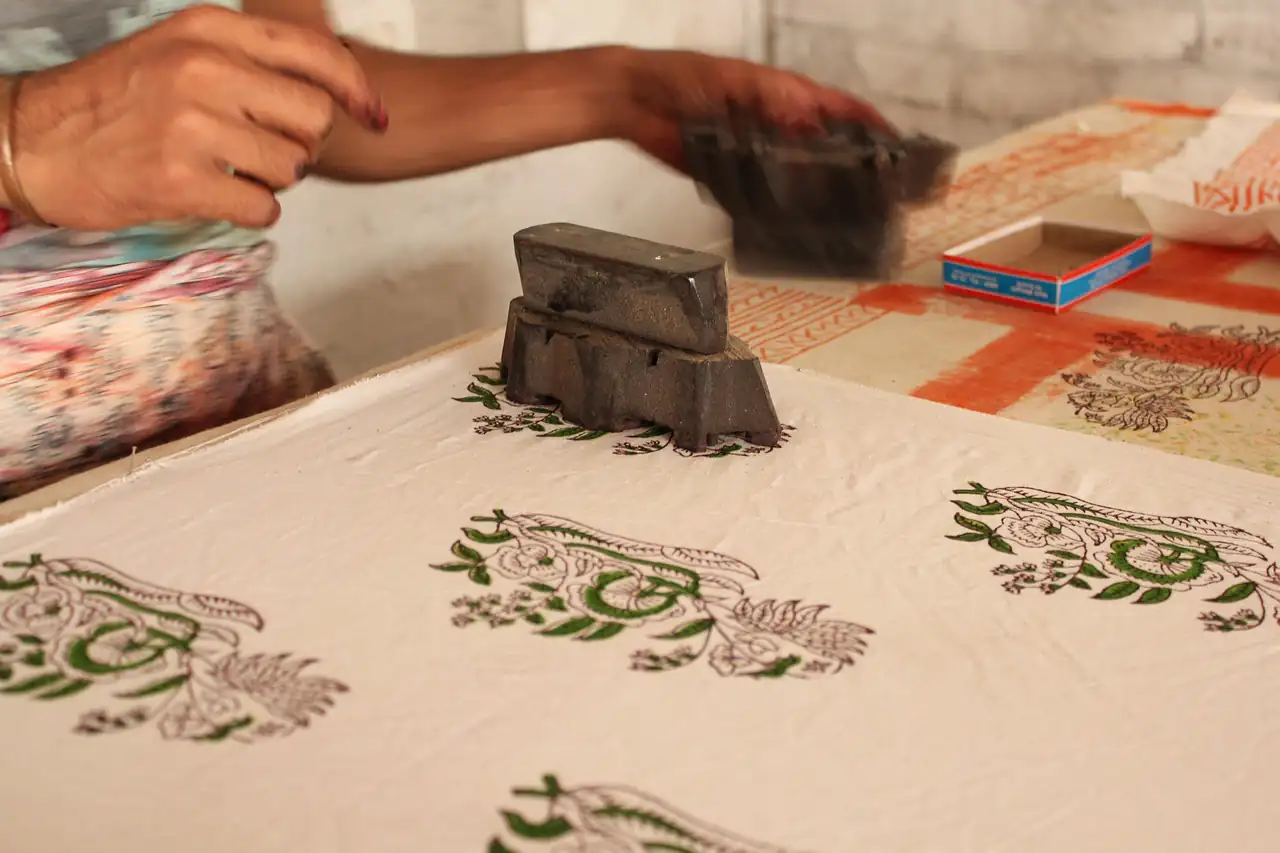
Hand block printing is done with carved wooden blocks, pressed by hand, one impression at a time, with each colour a separate block. A screen print is pushed through a mesh in one even pass. The results can look alike in a photo and very different in your hand. Here's what a buyer can check without a lab.
Look at the joins. A block is small, so a long length is printed in many impressions side by side. Where two impressions meet you'll often see a faint overlap, a hairline gap or a slight shift. A screen or rotary print repeats perfectly over a much longer distance. If every repeat is identical down to the edge, be suspicious.
Look at the colours against each other. Each colour in a block print is laid with its own block, so outlines and fills sit a fraction off from each other here and there. Perfect registration across five colours over metres of cloth is a screen trait.
Turn it over. Many block prints, especially with natural dyes and mud resist, show the pattern clearly on the back because the dye soaks through. Many pigment screen prints sit on the surface and look pale on the reverse. It's a clue, not proof, because methods vary.
Ask to see the blocks. A workshop that prints your design will have your blocks, carved for it, and will show you them. For a custom design you're often paying for them, so ask who owns them after the order. The same advice the Jaipur locals gave the visitor applies to a buyer: verify at the workshop, not in a shop (Jaipur cluster).
The GI register gives you one more check. Sanganer's GI lists 253 authorised users. If a supplier sells "Sanganeri" print, it's fair to ask whether they're a registered authorised user, and for the registration number. The register is public (IP India (opens in a new tab)). Being outside the list doesn't make a printer dishonest. Plenty of good workshops print in the Sanganer style without using the name. It only matters when the name is on your label.
What To Write Into The Spec
Forum buyers who order direct describe the same three surprises, and each one turns into a line on your spec sheet.
Base cloth weight. Indian block print is usually printed on light, voile-weight cotton, because it takes dye well. A UK sewist found her fabric "sheer and needs lining" (r/sewing, 2026). For a dress that may be fine. For a quilt, a cushion or a structured shirt it isn't. Specify the base by weight in grams per square metre, and by thread count if you can.
Ground colour. An EU buyer pointed out that many sellers print on unbleached cotton, so the ground "will not be white-white" (r/sewing, 2025). If you want a bright white ground, say bleached. If you like the natural ground, say that too, so the bulk matches.
Fibre content in writing. Another buyer found a listing advertised as rayon whose description said polyester (r/sewing, 2024). Ask for the fibre composition on the proforma invoice, and check it on arrival. It also decides your tariff line and your care label.
Then write the method: hand block, number of colours, dye type (natural, synthetic or pigment), and any resist technique such as dabu, Bagru's mud resist. A spec that says "block print" leaves every one of those open.
What To Test
Two things matter for importers in the EU and UK, and one for everyone.
Azo dyes. Bagru sellers market goods as "azo free" (r/IndiaBusiness, 2025, Supplier-stated), and that's a claim you test, not one you print unseen. EU and UK rules restrict textiles dyed with azo colourants that release certain amines. The limit we hold is reported, not read from the regulation, so confirm it with your lab. A lab test on the bulk fabric costs far less than a recall.
Colourfastness. Natural dyes and hand processes vary from batch to batch. One forum buyer found her block print stayed bright after frequent washing, which is reassuring but is one voice. Put wash and rub colourfastness grades in the PO, and test the bulk, not just the sample.
Shrinkage. Hand-finished cotton often hasn't been pre-shrunk. If you're making garments or bedding, agree a post-wash shrinkage limit before you cut.
The general inspection steps are on quality control in India, and AQL sampling explained covers what an inspection can see and what it can't.
Capacity, Weather And Lead Time
Block printing is hand work, and the printed cloth is sun-dried and often washed in the open. One Bagru studio put it simply: production "relies entirely on human hands and weather (sun drying)" (r/IndiaBusiness, 2026, Supplier-stated). That makes the monsoon the real constraint. The Jaipur page gives the season, and the practical point is that July to September orders need slack.
Small orders are realistic. Studios advertise very low minimums, and foreign small labels ask for 50 to 150 pieces per style (r/jaipur, 2026). We haven't seen a buyer confirm a tiny order delivered, so treat any minimum as something to agree in writing. Each new design needs new blocks, so the minimum is often about the blocks more than the cloth.
What It Pays At The Border
Most buyers import either printed fabric by the metre or finished goods (garments, quilts, table linen). Finished goods follow the rules for that product, so for a blouse see women's woven tops from India and for bedding bed linen from India. For printed cotton fabric, here's what we read on 7 October 2026.
Australia. 5% general, 0% under ECTA on the 5208 lines we read (DFAT (opens in a new tab)).
United Kingdom. 8% third-country on printed cotton plain weave over 100 g/m², 0% for India from 15 July 2026 (UK Trade Tariff, 5208520019 (opens in a new tab)).
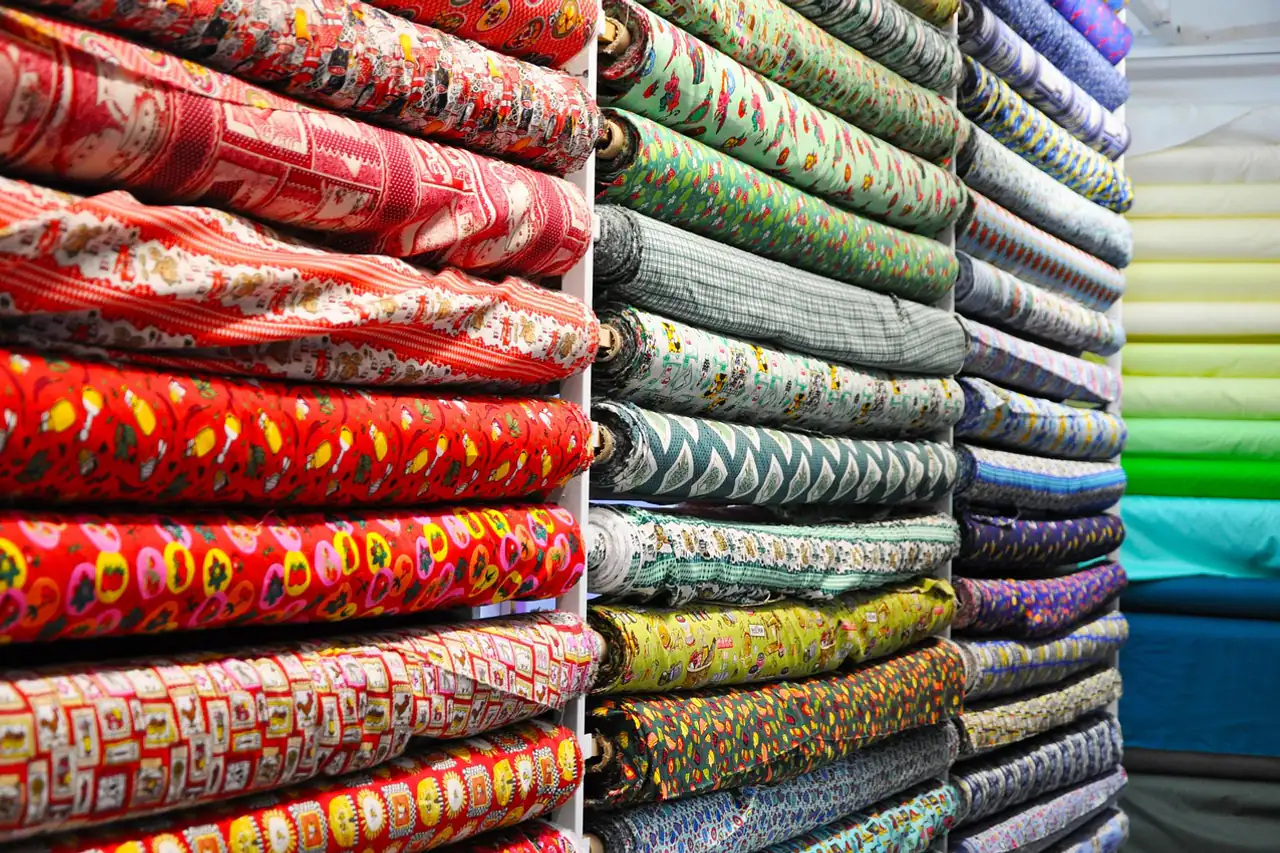
United States. It depends on the cloth. Printed cotton plain weave at or under 100 g/m² pays 8.1% for coarser yarns and 11.4% for finer ones. Over 100 g/m² it pays 6% and 11.4% (USITC (opens in a new tab)). The Section 301 duty on Indian goods comes on top (India to the US). A lower 3% rate exists for "certified hand-loomed fabrics", but block print on mill-woven cloth isn't hand-loomed. Only if your base is genuinely handloom and certified might it apply, so check this with your customs broker before you price on it.
The weight and yarn count of a voile base decide which US line applies, and that's a fact to get from a lab report or the mill, not a guess. HS codes explains how to confirm a code. For the EU, New Zealand and the UAE, see the EU, New Zealand and UAE pages.
Small direct orders bring a different problem. Forum buyers in the US say courier shipping "usually doubles the listed price" on small fabric orders (r/sewing, 2024). Below a certain size the landed cost eats the direct-buying advantage. Low-value imports explains the thresholds in each market.
Ready to act
Need hands-on help?
Finding a workshop that prints your own designs, checking blocks and bulk in Sanganer or Bagru, and booking lab tests is execution, not knowledge. SourcingSync does it for foreign buyers.
Questions Buyers Ask
Is Sanganer or Bagru better?
They're different. Practitioners describe Bagru for natural indigo and dabu, and Sanganer for synthetic-dye printing. Choose by the look and the dye you want, then test the claim.
Can I use "Sanganeri" or "Bagru" on my label?
Both are registered GIs. Use the name only for goods made by registered users in the protected area, and ask your supplier for proof. If you're unsure, describe the technique instead of the place.
Does block print fade?
Some does, some doesn't. It depends on the dye and the fixing. Set colourfastness grades in the PO and test the bulk.
Back To The Demo Shop
The visitor in Jaipur paid for a show and got good saris at a bad price. A buyer with a spec sheet avoids both halves of that. Go to the workshop, see the blocks, write down the cloth, the ground and the dye, and test what the label claims. Hand block print from Sanganer and Bagru is one of the best reasons to source textiles from India, and it rewards a buyer who knows exactly what they're asking for.
Keep India product guides open for the rest of your range.