

Leather Footwear From India: Agra, Kanpur or the Tamil Nadu Belt, and What Your Border Does With the Shoe
- Updated
Your route: leather footwear from India
Made in
Leaves India from
Mundra
IndicativeUseful directional information where precise verification is unavailable.UnknownInsufficient evidence, or not yet researched.
Also Pipavav, Nhava Sheva (JNPA), Chennai
At sea
35 to 46 days
11 scheduled sailings, port to port
Every port and sailing to United Kingdom
- Mundra to London Gateway: 35 to 46 days, 11 sailings
- Pipavav to London Gateway: 39 to 61 days, 8 sailings
- Pipavav to Felixstowe: 77 to 102 days, 3 sailings
- Nhava Sheva (JNPA) to London Gateway: 34 to 41 days, 8 sailings
- Chennai to London Gateway: 26 to 34 days, 9 sailings
Made in
Leaves India from
Mundra
IndicativeUseful directional information where precise verification is unavailable.UnknownInsufficient evidence, or not yet researched.
Also Pipavav, Nhava Sheva (JNPA), Chennai
At sea
38 to 38 days
6 scheduled sailings, port to port
Every port and sailing to European Union
- Mundra to Rotterdam: 38 to 38 days, 6 sailings
- Pipavav to Rotterdam: 38 to 64 days, 5 sailings
- Nhava Sheva (JNPA) to Rotterdam: 33 to 33 days, 6 sailings
- Chennai to Rotterdam: 23 to 31 days, 9 sailings
Made in
Leaves India from
Mundra
IndicativeUseful directional information where precise verification is unavailable.UnknownInsufficient evidence, or not yet researched.
Also Pipavav, Nhava Sheva (JNPA), Chennai
At sea
30 to 32 days
7 scheduled sailings, port to port
Every port and sailing to United States
- Mundra to New York/New Jersey: 30 to 32 days, 7 sailings
- Mundra to Savannah: 36 to 36 days, 7 sailings
- Mundra to Los Angeles/Long Beach: 45 to 62 days, 10 sailings
- Nhava Sheva (JNPA) to New York/New Jersey: 33 to 35 days, 8 sailings
- Nhava Sheva (JNPA) to Savannah: 38 to 40 days, 6 sailings
- Nhava Sheva (JNPA) to Los Angeles/Long Beach: 35 to 57 days, 12 sailings
- Chennai to New York/New Jersey: 31 to 43 days, 13 sailings
- Chennai to Savannah: 41 to 53 days, 15 sailings
- Chennai to Los Angeles/Long Beach: 36 to 55 days, 7 sailings
Made in
Leaves India from
Mundra
IndicativeUseful directional information where precise verification is unavailable.UnknownInsufficient evidence, or not yet researched.
Also Pipavav, Nhava Sheva (JNPA), Chennai
At sea
26 to 26 days
2 scheduled sailings, port to port
Every port and sailing to United Arab Emirates
- Mundra to Jebel Ali: 26 to 26 days, 2 sailings
- Mundra to Fujairah: 25 to 25 days, 6 sailings
- Pipavav to Jebel Ali: 12 to 12 days, 6 sailings
- Pipavav to Khor Fakkan: 27 to 36 days, 3 sailings
- Pipavav to Fujairah: 40 to 46 days, 2 sailings
- Nhava Sheva (JNPA) to Jebel Ali: 7 to 14 days, 9 sailings
- Nhava Sheva (JNPA) to Khor Fakkan: 2 to 6 days, 6 sailings
- Nhava Sheva (JNPA) to Fujairah: 2 to 7 days, 3 sailings
- Chennai to Jebel Ali: 20 to 44 days, 12 sailings
- Chennai to Khor Fakkan: 24 to 56 days, 12 sailings
- Chennai to Fujairah: 19 to 25 days, 2 sailings
Made in
Leaves India from
Mundra
IndicativeUseful directional information where precise verification is unavailable.UnknownInsufficient evidence, or not yet researched.
Also Pipavav, Nhava Sheva (JNPA), Chennai
At sea
29 to 42 days
21 scheduled sailings, port to port
Every port and sailing to Australia
- Mundra to Sydney: 29 to 42 days, 21 sailings
- Mundra to Melbourne: 26 to 36 days, 18 sailings
- Mundra to Brisbane: 26 to 39 days, 12 sailings
- Mundra to Fremantle: 21 to 49 days, 18 sailings
- Pipavav to Sydney: 35 to 61 days, 9 sailings
- Pipavav to Melbourne: 35 to 55 days, 8 sailings
- Pipavav to Brisbane: 32 to 58 days, 8 sailings
- Pipavav to Fremantle: 30 to 50 days, 8 sailings
- Nhava Sheva (JNPA) to Sydney: 25 to 39 days, 9 sailings
- Nhava Sheva (JNPA) to Melbourne: 20 to 40 days, 8 sailings
- Nhava Sheva (JNPA) to Brisbane: 22 to 36 days, 6 sailings
- Nhava Sheva (JNPA) to Fremantle: 15 to 52 days, 12 sailings
- Chennai to Sydney: 27 to 53 days, 19 sailings
- Chennai to Melbourne: 23 to 61 days, 21 sailings
- Chennai to Brisbane: 24 to 64 days, 15 sailings
- Chennai to Fremantle: 18 to 56 days, 15 sailings
Made in
Leaves India from
Mundra
IndicativeUseful directional information where precise verification is unavailable.UnknownInsufficient evidence, or not yet researched.
Also Pipavav, Nhava Sheva (JNPA), Chennai
At sea
55 to 89 days
9 scheduled sailings, port to port
Every port and sailing to New Zealand
- Mundra to Auckland: 55 to 89 days, 9 sailings
- Pipavav to Auckland: 82 to 97 days, 5 sailings
- Nhava Sheva (JNPA) to Auckland: 30 to 80 days, 22 sailings
- Nhava Sheva (JNPA) to Tauranga: 37 to 39 days, 16 sailings
- Chennai to Auckland: 30 to 86 days, 31 sailings
- Chennai to Tauranga: 37 to 39 days, 16 sailings
We have not yet researched which port Kanpur ships through. Carrier schedules read 23 Sept 2026. Days are port to port; inland haul and customs time come on top.
Add up the landed costFind the HS codeGet help shipping it (opens sourcingsync.com in a new tab)
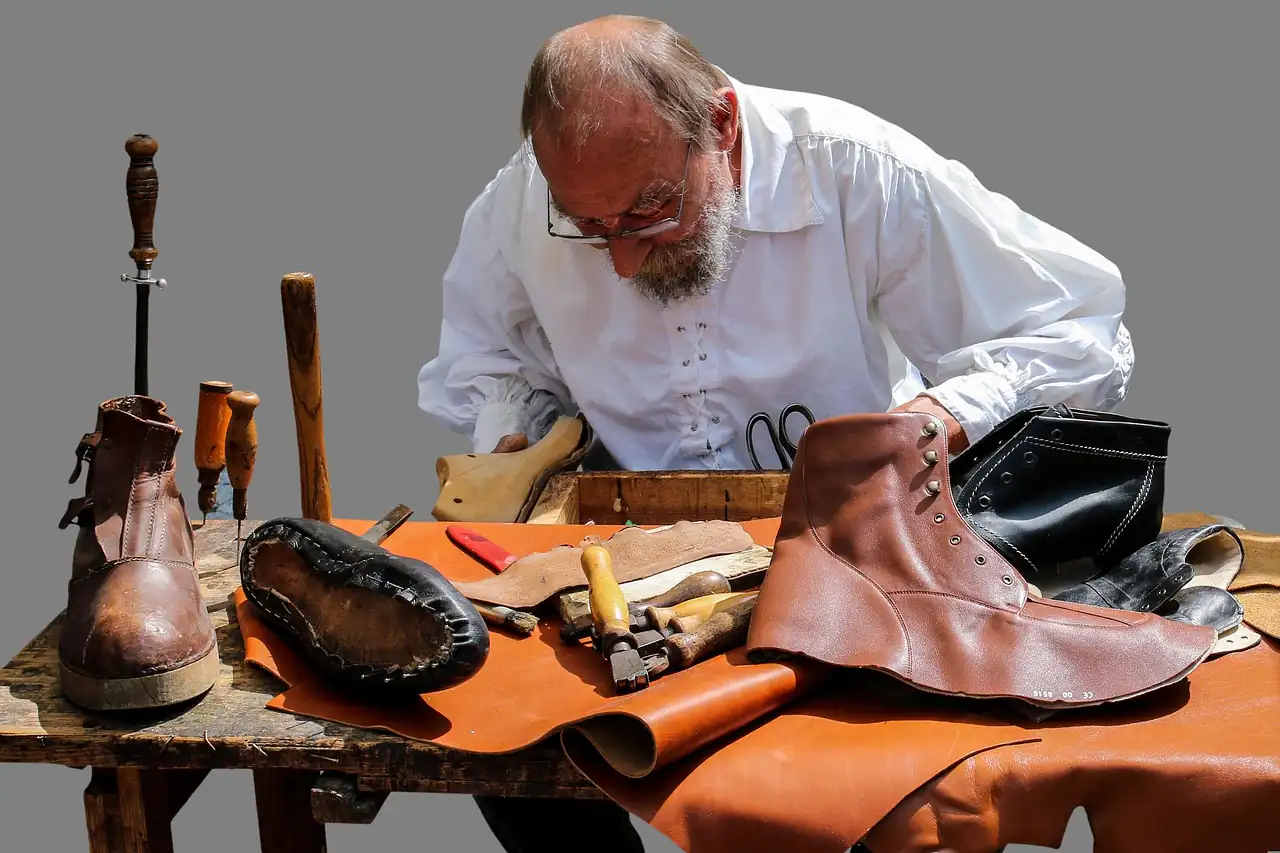
How many shoes does Agra make in a day? The district administration's own page says "above 1.5 lakh pairs", which is 150,000. A study published by the Centre for Science and Environment in September 2024 says the city "churns out 0.9 to one million pairs of footwear every day" (Agra district page (opens in a new tab), CSE, 4 September 2024 (opens in a new tab)). The two numbers are about six times apart, and neither is careless. Agra's shoes come from about 60 organised factories, 3,000 tiny units and roughly 30,000 household artisans, by the district's count, and nobody counts the last group the same way twice.
The same district page says only about 70 units export. So "Agra" on a letterhead can mean a proper export factory, or a merchant exporter placing your order across a street of home workers, and both are normal ways to make shoes in India. Your job is to know which one you've got. This page helps you pick the right footwear centre for your shoe, shows what each border charges by how the shoe is built, and covers the checks that actually stop a shipment. How to specify the shoe is on the global leather footwear page, and the chemistry every leather order shares is on leather and footwear. Our shipment records are US records, and we publish no prices.
Start With The Shoe, Then Pick The Town
Each centre has its own page, so here's only what decides a footwear order.
A volume leather shoe, men's or women's. Look at Agra and the Tamil Nadu belt first. Agra is many small and mid-sized makers with job work through households, and that suits a buyer who wants a modest first order and is willing to check who answers for quality. The Tamil Nadu belt, Ambur, Vaniyambadi, Ranipet and Vellore, sits beside its own tanneries. The state's industries minister claimed in November 2023 that Tamil Nadu makes 32% of India's footwear and 48% of its footwear exports, leather and non-leather together (LatestLY, 21 November 2023 (opens in a new tab)). That's a minister talking, so take the shape and not the decimals.
Something heavy, or footwear alongside saddlery. Kanpur. Its makers hold three of the ten largest named footwear shipper slots in our US count. Its leather supply has been shaken, with a 2023 report counting 215 of 402 listed tanneries still running and many tanners moving to Bengal (DT Next, 13 August 2023 (opens in a new tab)). So the question for a Kanpur maker is which tannery supplies the hide today, and whether it's the one in your test report.
A range mixing shoes with bags and belts. Kolkata, where the Bantala leather complex holds 538 tanneries and hundreds of footwear and leather goods units (The Wire, 4 September 2025 (opens in a new tab)). The bag side is on leather bags from India.
Jalandhar is the thinnest choice for export shoes. A 2020 report counted about 200 leather units there making shoes, bags, jackets and belts (The Tribune, May 2020 (opens in a new tab)), and the town didn't appear among footwear shippers in our US count. It can suit a buyer whose range mixes leather with sports goods.
One check before you compare quotes. A shoe with a leather upper is heading 6403. A textile or synthetic sports shoe isn't, and the duty can be twice as high. The UK charges 16% on the textile sports line we read against 8% on most leather lines. So the upper is a duty decision as well as a design one.
Reading A US Bill Of Lading For A Shoe
Say you've found your shortlisted supplier on a public US shipping record, and the shipper on the bill is a Chennai logistics company. Don't panic. That's the single largest named shipper of Indian leather shoes in our count, and nearly half of named shoe bills carry a forwarder's name. Consolidators are an ordinary, useful part of getting shoes to America.
What the bill gives you is who booked the cargo, not who lasted and stitched the shoe. So ask the supplier for three things in writing: the factory address, the exporter of record, and the tannery. Then have someone walk into the factory. That's the step a foreign buyer can't do from a desk, and SourcingSync (opens in a new tab) can do it.
The port is the second oddity. Colombo and Salalah on a bill usually mean transshipment, the box changed ships there, so the bill won't tell you whether your shoes left Chennai, Nhava Sheva or Mundra. Put the Indian loading port in your quote. For northern makers it matters. In a straight line Agra is 972 km from Mundra and 1,051 km from Nhava Sheva by our computation, and Kanpur cargo may go east to Kolkata instead. Quote FCA at a named depot so the inland leg is priced in the open.
One Range Into The US
Footwear duty depends on construction as much as origin, and the US shows it most sharply. Take a typical range and run it through the HTS, which we read on 5 October 2026 (USITC (opens in a new tab)).
- A leather-strap sandal (6403.20) comes in free.
- A turn-construction loafer (6403.59.15) pays 2.5%. A welted boot (6403.51.30 or 6403.99.40) pays 5%.
- A men's shoe that isn't welted or turned (6403.51.60, 6403.99.60) pays 8.5%, and most women's and other shoes (6403.51.90, 6403.99.90) pay 10%.
Every one of them then pays the 10% Section 301 duty on Indian goods (India to the US). India has no preference column to claim. Welt, turn and the men's or other split are decided by how the shoe is made, so write the construction into the spec and have your customs broker confirm the line before you price it in the landed cost calculator.
The other borders are simpler.
- UK. The normal rate is 8% on most leather lines, 4% on the women's line we read and 8% on leather-strap sandals. Under the deal since 15 July 2026, Indian leather footwear was 0% on every line we read, with proof of origin. The origin rule for chapter 64 is a change of tariff heading with no value test, so imported leather and soles don't break it (UK-India CETA, Annex 3A (opens in a new tab)). Proofs are on India to the UK.
- Australia. A 5% base rate on the lines we read except strap sandals and ski boots, and 0% under ECTA with a certificate (India to Australia).
- New Zealand. 10% on adult leather footwear until 19 October 2026, then 0% under the FTA. The arrival date on your entry sets the rate, not the sailing date (India to New Zealand).
- EU. India keeps its GSP preference on footwear, which the 2026 suspension leaves out, so you need a REX statement from the exporter. We haven't read the live rate in TARIC (India to the EU). Cattle leather also falls under the EU deforestation regulation from 30 December 2026 for large and medium operators, so ask now where the hides came from.
- UAE. The leather council reported in March 2022 that the UAE gave Indian footwear 0% under the CEPA (CLE circular (opens in a new tab)). Ask your clearing agent to confirm your line and whether shoes need a conformity certificate (India to the UAE).

What Stops A Shoe At The Border
Chromium VI, in every leather part. The EU and GB limit is 3 mg/kg in leather that touches the skin, tested to EN ISO 17075, and each part must pass (Regulation 301/2014 (opens in a new tab)). In a shoe that's the lining and the insole as well as the upper. Ask the lab to sample each leather part, colour by colour. The full test plan and the alert count are on leather and footwear, and the destination plan on quality control in India.
The parts that aren't leather. The Malta alert is the reminder. A pair of Indian-origin shoes failed on plasticisers, chlorinated paraffins, lead and nonylphenol ethoxylates, and none of that comes from a tannery. Test soles, PVC trims, adhesives and prints too. Children's shoes carry extra rules in every market, so ask your test lab.
Exotic trim. The UK tariff flags CITES controls on every leather-upper line we pulled, because a shoe can carry python or crocodile. Cattle, buffalo, goat and sheep leather isn't the issue. If your design uses an exotic species you need CITES permits at both ends, and the US also wants Fish and Wildlife Form 3-177 (USFWS (opens in a new tab)). India has also reportedly banned reptile-skin exports from February 2025, by PETA India's account (PETA India (opens in a new tab)). We haven't read the notification itself, so check this with your customs broker before you design with exotic trim. For ordinary shoes, write "no CITES-listed species" into the order.
The labels. The US requires the country of origin on the shoe in English, legible and permanent, and CBP rulings have accepted a stitched tag under the tongue or a label near the top inside the tongue (19 CFR Part 134 (opens in a new tab)). The EU and UK want the material of the upper, lining and sock, and outer sole shown by pictogram or words (Directive 94/11/EC, as carried into GB law (opens in a new tab)). Confirm both on the approved sample, because re-marking at the border is a cost nobody budgets.
Questions Buyers Ask
Why do some US boot buyers say "Made in India" means poor quality?
One review of an India-made US brand's welted boots complained of "terrible quality control, defects, and color variations between pairs" (r/goodyearwelt, January 2021 (opens in a new tab)), while others in the thread defended the construction. That reads as a spec and inspection problem. Write pair matching into the spec, both shoes from the same hide lot, and inspect finished pairs with AQL sampling.
Do I need an origin certificate for shoes?
For the lower rate in Australia, the UK, New Zealand and the UAE, yes. The US rate doesn't depend on one. See rules of origin and certificates of origin.
Is the Tamil Nadu tannery belt clean enough to buy from?
Ask about the tannery, not the belt. In 1996 India's Supreme Court heard that untreated tannery effluent had damaged the Palar river and nearly 35,000 hectares of farmland, and ruled that the industry could not continue unless it dealt with the pollution it had caused (Vellore Citizens Welfare Forum v. Union of India, 28 August 1996 (opens in a new tab)). Treatment plants are now part of how the belt works, and the Leather Working Group's public directory lists audited tanneries around Ranipet, Ambur and Vellore (LWG (opens in a new tab)). A tannery that isn't listed isn't a bad one. It just means you ask for its audit.
Where To Meet Makers
The India International Footwear Fair in New Delhi is set for 5 to 7 August 2027 and suits northern makers. The India International Leather Fair is in Chennai, on the doorstep of the tannery belt, with 2027 dates not yet announced. A day at a maker's own cutting table, with its tannery's test report in your hand, will tell you more than either hall.
Ready to act
Need hands-on help?
Factory visits, tannery checks, witnessed lab sampling and pre-shipment inspection of finished pairs are execution, not knowledge. SourcingSync does it.
Back To Agra's Two Numbers
If the people who count Agra's shoes can be six times apart, a capacity figure on a brochure proves nothing. What does count is a factory you've seen, a tannery you can name and a test report that matches your hide lot. Get those three, and the duty and the dates are paperwork. For the other leather lines, see the India product guides.